

The silk scarf has become one of those fashion items that reveals how seriously someone takes their wardrobe. Not because it signals wealth, which it doesn't particularly, but because knowing how to wear one requires having thought about proportions, textures and the geometry of the neck. The four scarves below span the full accessible range of the category, from a £15 Mango twill to a £415 Hermès carré, and the report compares them on the one thing most reviews skip: how the silk actually behaves when you knot it.
We tested each over six weeks of regular rotation. The scarves were worn as neck ties with knits, as head wraps on windy days, as bag handles on the Polène tote, and in the full square-folded shape over coat lapels. The findings are not what the price order would suggest. Some of the £15 Mango performance was genuinely impressive. Some of the £415 Hermès ritual felt deserved. The gap between them is narrower than you'd expect for the first hour of wear and wider than you'd expect by year three.
Momme Weight, Explained Without Pretension
Silk weight is measured in momme, which is a Japanese unit roughly equivalent to the grammage of a specific area of silk. Lightweight scarves run 8 to 10 momme. Medium-weight scarves run 12 to 16 momme. Heavy twill silk runs 18 to 22 momme. The Hermès carré is 20 momme twill, which is why it holds a knot and doesn't blow around in the wind. The Mango scarf is roughly 10 momme, which is why it drapes beautifully for photos and slides straight out of a loose knot within an hour.
The practical point: momme weight determines what the scarf can do, more than any other variable. A lightweight scarf is better for head wraps and bag handles because it's more pliable. A heavyweight scarf is better for neck knots because it holds position. The right scarf for you depends on how you plan to wear it, not on what the brand suggests.
Toteme's silk scarf (£180, 16 momme, hand-rolled hem, Italian silk twill) sits in the middle weight band. It knots cleanly, drapes well, and reads sophisticated. The hand-rolled hem is the detail that distinguishes it from fast-fashion equivalents at a tenth the price. A machine-stitched hem reads flat; a hand-rolled hem has a slight pillow effect that catches light at the edge.
COS's silk square (£55, 14 momme, machine-rolled hem, Chinese silk) is the surprising performer. The silk weight is credible, the printing is clean, and the hem, while machine-done, is tidy. The one tell is the slightly slick hand-feel; the silk hasn't been washed to the softness of the Hermès or Toteme, and it reads newer than it should on day one. After the second wash, this closes significantly.
The Hermès Carré, Honestly Assessed
The Hermès carré 90 (£415, 20 momme, twill, hand-rolled hem) is a different category of product. The silk is a specific weight and twill structure that Hermès has used since the 1930s. The printing is screen-printed in Lyon using up to forty colours, each a separate screen pass, with the whole process taking approximately two years from design to finished scarf. The hem is hand-rolled by rolleuses who train for years.
The result is a scarf that feels heavier in the hand than the price suggests, holds a knot indefinitely, and ages beautifully. The one that gets passed to a daughter in twenty years is this one. The resale value is also unusual: a Hermès carré in good condition holds roughly sixty-five to eighty per cent of retail on Vestiaire Collective, which means the effective cost of ownership is remarkably low if you treat it well.
The wry observation: the Hermès scarf is intimidating because it has become shorthand for a particular kind of grown-up Parisian elegance that most of us can't quite pull off casually. The trick is to wear it slightly wrong. Knotted asymmetrically with denim and a crisp white shirt, it reads modern. Folded neatly over a camel coat with a tweed skirt it reads costume. The scarf is doing less of the work than you'd think, which is both the challenge and the reward.

Knotting Behaviour: What Actually Holds
The classic neckerchief knot requires a medium-weight silk and a 90cm square. Hermès and Toteme both do this well. The COS does it reasonably. The Mango does it for forty minutes, after which the knot creeps loose and needs resetting.
The bandana knot at the back of the neck wants a lighter silk and a smaller 70cm square. The COS does this best among the four, because the lighter weight follows the curve of the neck. The Hermès, counter-intuitively, is almost too heavy for this knot and sits slightly stiffly.
The headwrap requires a lightweight silk and a 90cm square minimum. The Mango excels here, because the lightweight silk hugs the head and holds through wind if you tie it properly. The Hermès reads formal in this knot and tends to look costume unless you're going for a specific aesthetic.
The bag handle wrap wants a lightweight silk and either a 70cm square or a 90x12cm oblong. All four work, but the Mango and COS do it best because the lighter weight wraps more neatly around a thin bag strap.
Printing Quality and Durability
The printing is the second variable that separates the price points. Hermès uses silk-screen printing with as many as forty colour passes. The result is a dense pigmentation that saturates the silk completely, meaning the colours look the same on front and back. The Toteme uses rotary digital printing with lower pigment density but excellent registration, meaning the pattern lines up precisely at the hem and corners.
The COS uses digital printing with reasonable pigment density. The pattern will fade slightly after ten washes but is holding up at six so far. The Mango uses digital printing with lighter pigment density. Visible pattern fade after four wash cycles, which is the honest limitation of a £15 scarf.
The contrarian point: the printing quality matters less than you'd think for most occasions. A scarf tucked inside a coat collar is seen in flashes, not studied, and the pattern fade on the Mango is less visible than the Hermès marketing would have you believe. Pattern fade matters for scarves you plan to pass on. For scarves you plan to wear through five years and replace, it's a minor factor.
Styling: Beyond the French Girl Default
The French girl silk scarf moment of 2022 has settled into something more considered. The current styling is less about the scarf as the centrepiece and more about the scarf as a textural layer. Knotted small at the neck under a crew-neck knit so just the edge shows. Tied through belt loops of a cream trouser. Wrapped once around the wrist as a cuff. Looped through the strap attachment of a shoulder bag.
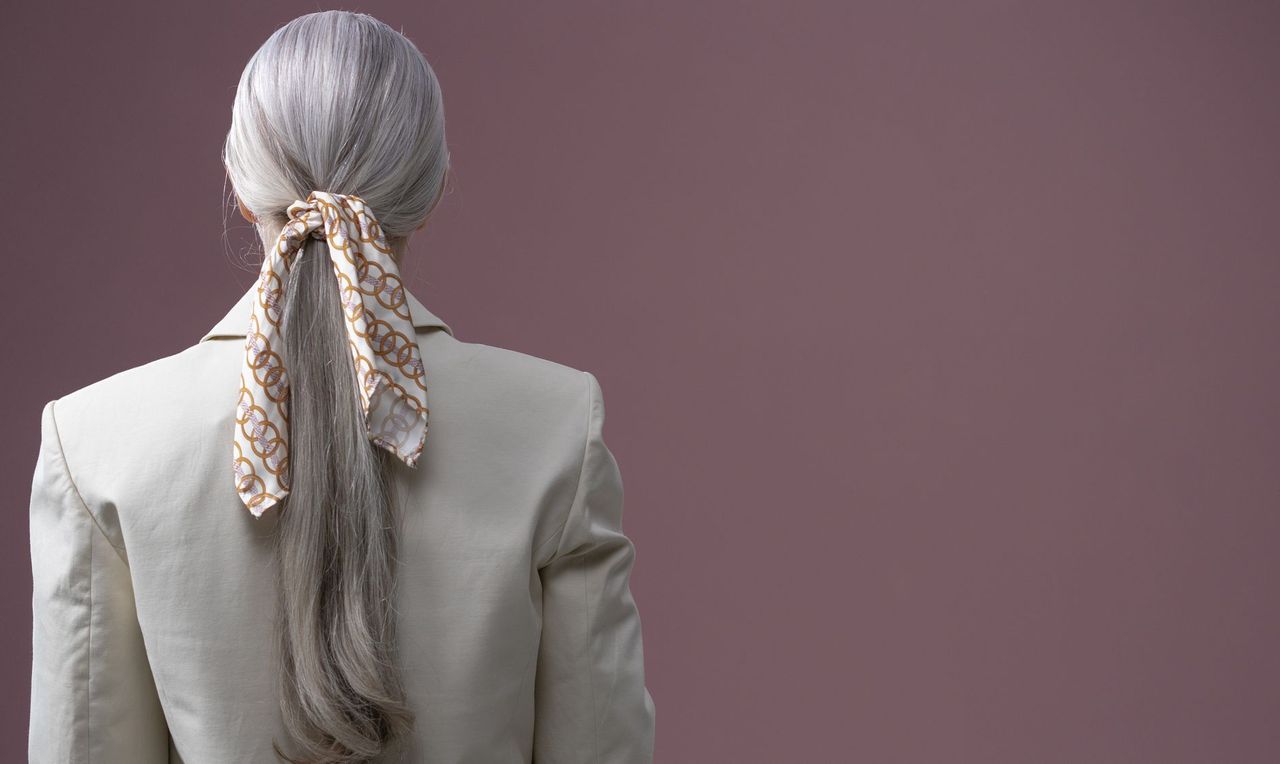
The scarf as hair accessory is making a return for autumn 2026, specifically as a long oblong wrapped once around a low ponytail and knotted asymmetrically. This looks exceptional on long hair and gets more editorial impact than any other knot. The Mango 70cm square doesn't quite reach for this. The Hermès and Toteme both work beautifully, the Toteme perhaps slightly better because the slightly softer silk follows the hair line more easily.
The headscarf tied under the chin is still associated with the Queen, which depending on your sensibility is either lovely or hopeless. It works if the scarf has strong colour and you commit fully. It fails if you half-commit and look like you're trying.
Cost per Wear and the Honest Picture
A silk scarf worn twice a week through autumn and winter is a scarf worn roughly fifty times a year. The Mango at £15 lasts perhaps two seasons before the pattern fades noticeably and the hem starts to fray. Effective cost per wear works out to 15p. The COS at £55 lasts four or five seasons, giving a cost per wear of around 27p. The Toteme at £180 lasts ten years with care, giving 36p per wear. The Hermès at £415, worn fifty times a year for fifteen years and then passed on, delivers around 55p per wear.
The scarf you'd actually buy depends on how you shop. The Mango is the right scarf if you want to try the trend without commitment. The COS is the right scarf if you want a credible everyday piece. The Toteme is the right scarf if you want to buy once and keep. The Hermès is the right scarf if you want an object with a specific cultural weight and resale value.
| Scarf | Brand | Price | Momme Weight | Best For |
|---|---|---|---|---|
| Printed twill square | Mango | £15 | ~10 | Head wraps, bag handles |
| Silk square | COS | £55 | ~14 | Everyday neck ties, hair |
| Printed silk scarf | Toteme | £180 | 16 | Classic knots, hair wraps |
| Carré 90 | Hermès | £415 | 20 | Investment, formal, resale |
Do's and Don'ts
| Do | Don't |
|---|---|
| Match momme weight to the knot you want | Buy the cheapest and expect it to behave the same |
| Hand-wash in cold with silk shampoo | Machine-wash silk scarves of any price |
| Iron on the reverse under a cotton cloth | Iron the printed side at any temperature |
| Store flat or on a padded hanger | Scrunch into a drawer with hard objects |
| Rotate between two or three scarves | Wear the same scarf daily for a season |
| Knot asymmetrically for modern silhouettes | Tie neat symmetrical bows for 1950s revival |
| Commit fully to the scarf or skip it | Half-commit and look uncertain |
| Try the hair wrap for autumn 2026 | Default to the neckerchief every time |
| Pair silk with wool and leather | Pair silk with other silk or satin |
| Research the hem construction | Assume all silk scarves are made equally |
Frequently Asked Questions
What's the single best scarf for someone starting out
The COS silk square at £55. It's credible silk, cleanly printed, holds knots reasonably well, and costs little enough to experiment with. Buy a solid colour or geometric print rather than a figurative design, which will date faster.
Is Hermès actually worth £415
If you'll wear it fifty times a year for a decade or more, yes. If you'll wear it twice a year to a wedding, no. The scarf is designed for daily use by someone who cares about construction, and the price reflects materials and labour rather than brand markup.
How do I wash a silk scarf without ruining it
Hand-wash in cold water with a specialist silk detergent or baby shampoo. Agitate gently, rinse until the water runs clear, press (don't wring) excess water out, lay flat on a towel to dry. Iron on the reverse through a thin cotton cloth on silk setting.
What size should I buy as a first scarf
A 70cm square is the most versatile starter size. It handles neck knots, hair wraps and bag handles without being overwhelming. A 90cm square gives more styling options but reads slightly formal on smaller frames.
Can I wear a silk scarf to the office
Yes, in most British office cultures. Knotted small at the neck under a crew knit reads polished. A larger scarf worn as a drape over coat lapels for the commute reads sophisticated. Avoid full headscarves for most office settings.
What's the mistake most women make with silk scarves
Buying a scarf without considering the momme weight. A beautiful print on a 10 momme silk will slip, fail to hold knots, and frustrate the wearer within an hour. Weight before pattern.
Will the Hermès carré hold its value
Yes, provided the condition is maintained. Hermès carrés in good condition resell at sixty-five to eighty per cent of retail on authenticated platforms. The pieces that hold value best are classic designs rather than seasonal collaborations.
Can I wear a silk scarf year-round
Yes, in different weights. A heavier twill silk works for autumn and winter over coats and knits. A lightweight habotai silk works for spring and summer at the neck or as a hair wrap. The scarf is not strictly a cold-weather accessory.