

There are creative-director appointments, and then there is Matthieu Blazy Chanel — a sentence the industry spent eighteen months trying to manifest and then, when it finally arrived, still couldn’t quite believe. For a house that treats succession the way monarchies do, handing the keys of Rue Cambon to a 41-year-old Belgian who made his name turning cowhide into denim at Bottega Veneta was never the obvious play. It was the interesting one. It was also, arguably, the only one that could follow the quiet unraveling of the Virginie Viard years without turning the whole exercise into a nostalgia act. Chanel didn’t need another curator of Karl’s greatest hits. It needed a designer with a point of view strong enough to stand in front of Coco’s mirrored staircase and not flinch.
What Blazy has delivered so far — one ready-to-wear debut, one couture outing, and a pre-fall lookbook that leaked out of Place Vendôme like a rumor — suggests he understood the assignment better than anyone betting against him. His Chanel isn’t a reinvention in the Hedi-at-Celine, scorched-earth sense. It’s slower, stranger, more forensic. He’s reading the archive like a novel, not a catalog, and the SS26 show at the Grand Palais in March 2026 made it obvious he plans to rewrite entire chapters. Here’s the real inside read on who Blazy is, what he did at Bottega, what his debut actually revealed, and which of the sacred codes he’s protecting versus quietly retiring.
Who Matthieu Blazy Actually Is (And Why Chanel Chose Him)
Blazy is not a personality designer. He doesn’t post, he rarely gives interviews, and when he does, he talks about materials the way chefs talk about stock. Born in Paris, raised between Belgium and France, trained at La Cambre in Brussels, he built his resume in the rooms where craft gets interrogated: Raf Simons at Jil Sander, Maison Margiela’s Artisanal atelier under Martin Margiela himself, then Celine under Phoebe Philo, then Calvin Klein with Raf again, and finally Bottega Veneta, where he succeeded Daniel Lee as creative director in November 2021. That CV is not a coincidence. It’s the most quietly rigorous design education in luxury, and it made him the rare candidate fluent in both haute atelier culture and the kind of minimalist tailoring Chanel had been starved of. When the Wertheimers needed someone who could speak to Coco’s obsession with how clothes move on a real body, they hired the man who had spent three years proving you could sculpt flannel out of a calfskin.

The Bottega Years: Trompe L’Oeil, Intrecciato, and a Craft Revival
Blazy’s 2021–2025 run at Bottega Veneta is already being taught in fashion schools, and rightly so. His first show introduced the now-legendary trompe l’oeil leather jeans — perfectly pressed, perfectly worn-in denim that turned out to be hand-painted nappa — and the trick wasn’t the gimmick, it was the philosophy. He treated leather as a language, not a category, and built an entire universe around it: the Kalimero bag in 2022, the Andiamo in 2023, the knitted leather sock-slippers, the flannel shirts that weren’t flannel at all. He revived intrecciato as a technique rather than a logo and gave the Green credibility Daniel Lee’s viral phase never quite earned. By the time Kering confirmed in December 2024 that Louise Trotter would succeed him at Bottega, Blazy had already tripled the house’s fashion gravity and was openly being discussed as Chanel’s next artistic director. The industry saw it coming. The speed with which it actually happened still shocked people.

The Viard Exit and the Eighteen-Month Vacuum at Chanel
To understand why Blazy’s arrival feels like a reset, you have to remember how strange the transition was. Virginie Viard — Karl Lagerfeld’s right hand for nearly thirty years and his direct successor from 2019 — left Chanel on June 5, 2024, with immediate effect and no successor named. Chanel spent the rest of 2024 running on studio autopilot, pushing out a cruise show and a couture collection without a single attributed designer, which in this industry is the equivalent of a royal family refusing to name an heir. The rumor mill churned through Pierpaolo Piccioli, Sarah Burton, Hedi Slimane, even Jonathan Anderson. When Blazy’s appointment was finally confirmed in late 2024 for a 2025 start, it closed a chapter the house had been quietly struggling to write since Karl’s death in 2019. Viard’s Chanel was gentle, nostalgic, sometimes flat. Blazy’s, on the early evidence, is none of those things.

Inside the Grand Palais: What SS26 Actually Looked Like
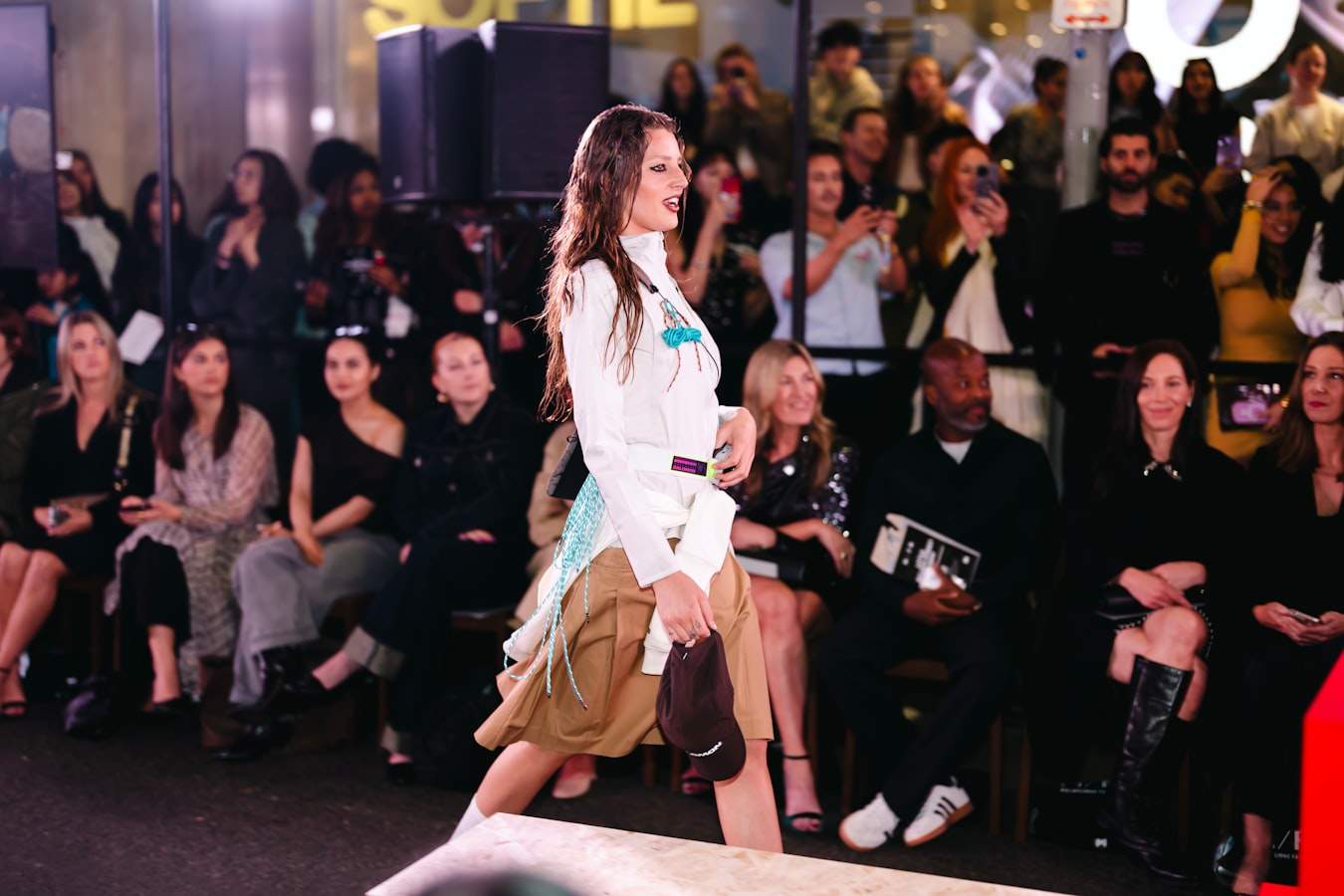
The ready-to-wear debut at the Grand Palais in March 2026 is the one everyone will remember, and not because it was loud. It was the opposite. Blazy took his bow in jeans and a T-shirt — a gesture no previous Chanel designer would have dared — and the collection itself read as what critics are calling a “quieter revolution.” Tweed and bouclé appeared weightless, cut into oversized blazers with masculine shoulders and low-slung trousers that moved like pyjamas. Charvet collaborated on the shirting, pulling from Coco’s menswear obsession rather than her 1980s Hollywood phase. The 2.55 reappeared broken-in and softened, almost slouchy, photographed as if it had already lived a life. Jersey and silk did most of the quiet work, and the palette — ivory, black, a bruised pink, a deep navy — stripped out the sugar Viard had been adding. The Grand Palais rose in a standing ovation. Anna, Edward, the whole front row. Vogue Scandinavia called the follow-up couture outing a study in “lightness and metamorphosis.” AnOther said Blazy was “transmogrifying the simple into the sublime.” The read was unanimous: this is a Chanel that intends to be thought about.

What He’s Keeping from Coco, Karl, and Viard
Blazy is too smart to burn the codes. The tweed is staying. The chain, the camellia, the pearl, the quilted leather, the two-tone shoe — all present, all recalibrated. What he’s keeping from Coco is the menswear DNA, the borrowed-from-the-boys tailoring, the insistence that a Chanel woman should be able to walk, sit, and breathe in what she’s wearing. What he’s keeping from Karl is the scale and the theatricality of the set (the Grand Palais itself is non-negotiable). What he’s keeping from Viard, interestingly, is the softness — her looser silhouettes, her distrust of corsetry. What he’s quietly burning is the logo-heavy, bow-in-the-hair, tourist-gift-shop Chanel that crept in during the late Lagerfeld years and never fully left. Matthieu Blazy Chanel is, if the first two shows are a map, going to be a house for grown-up women again.

How to Read a Chanel Under Blazy: Do’s and Don’ts
| Do | Don’t |
|---|---|
| Watch the fabrics first — Blazy speaks through material | Don’t fixate on logo placement; he’s moving away from it |
| Expect menswear references pulled from Coco’s own wardrobe | Don’t expect the bow-and-boater camp of late Karl |
| Read the 2.55 as a mood object — softened, lived-in | Don’t assume every bag is a new It-bag drop |
| Look for Charvet shirting and pyjama tailoring | Don’t expect corsetry or structured eveningwear |
| Track the palette: ivory, navy, bruised pink, black | Don’t wait for neon or sugar tones |
| Treat the Grand Palais set as part of the message | Don’t skim the show notes — Blazy writes them carefully |
| Follow the couture atelier credits | Don’t confuse couture drama with ready-to-wear restraint |
| Watch front-row casting for cultural signals | Don’t read celebrity seating as the full story |
| Expect intrecciato DNA to migrate from Bottega subtly | Don’t expect him to repeat himself |
| Judge him by the third collection, not the first | Don’t write the verdict after one runway |
FAQs
Who is Matthieu Blazy and why did Chanel hire him? Blazy is a Belgian-French designer, 41, trained under Raf Simons, Martin Margiela and Phoebe Philo, and most recently creative director of Bottega Veneta from 2021 to 2025. Chanel hired him because he combines atelier-level craft fluency with a minimalist, material-first point of view — exactly the corrective the house needed after the Viard years.


When did Virginie Viard leave Chanel? Viard exited on June 5, 2024, with immediate effect, after nearly thirty years at the house and five as artistic director. Chanel ran without a named designer for months before confirming Blazy.
When was Blazy’s Chanel debut? His ready-to-wear debut was the SS26 show at the Grand Palais in March 2026, followed by his first haute couture collection shortly after. Both were met with standing ovations and serious critical praise.
Who replaced Blazy at Bottega Veneta? Louise Trotter, previously creative director at Carven and Lacoste, was named Bottega Veneta’s creative director in December 2024 and started at the end of January 2025.
What did Blazy do at Bottega Veneta that made him famous? He’s best known for his trompe l’oeil leather work — most famously leather pieces painted and treated to look exactly like worn denim or flannel — and for reviving intrecciato as a craft statement rather than a logo.
Is Blazy keeping the classic Chanel codes? Yes, but selectively. Tweed, bouclé, the 2.55, the camellia, pearls and chains all remain. What’s being retired is the logo-forward, overtly decorative Chanel of the late Lagerfeld era.
How does his Chanel compare to Karl Lagerfeld’s? Karl’s Chanel was theatrical, maximalist, and culturally noisy. Blazy’s is quieter, more tactile, and more focused on how clothes actually feel on the body. Different instruments, same house.
Should I buy into SS26 as an investment piece? The softened 2.55 and the Charvet-collaboration shirting are the early collector picks. First-season pieces from a major creative-director debut historically hold value, and Blazy’s are already being chased on resale.
Conclusion
The Matthieu Blazy Chanel era is not going to be loud, and that is precisely why it’s going to matter. He inherited a house weighted down by its own mythology — Coco’s ghost, Karl’s shadow, Viard’s cautious interregnum — and instead of shouting over it, he’s turning the volume down until you can actually hear the fabric. The Grand Palais debut was less a coronation than a thesis statement: Chanel is a craft house, a menswear-inflected tailoring house, a house for women who dress for themselves. If he keeps his nerve through the next four seasons, this will be the reference point the 2030s fashion conversation circles back to. The real test starts with pre-fall. The real verdict comes with FW27. Either way, the most mythologized house in fashion finally has a designer worth the myth again.