

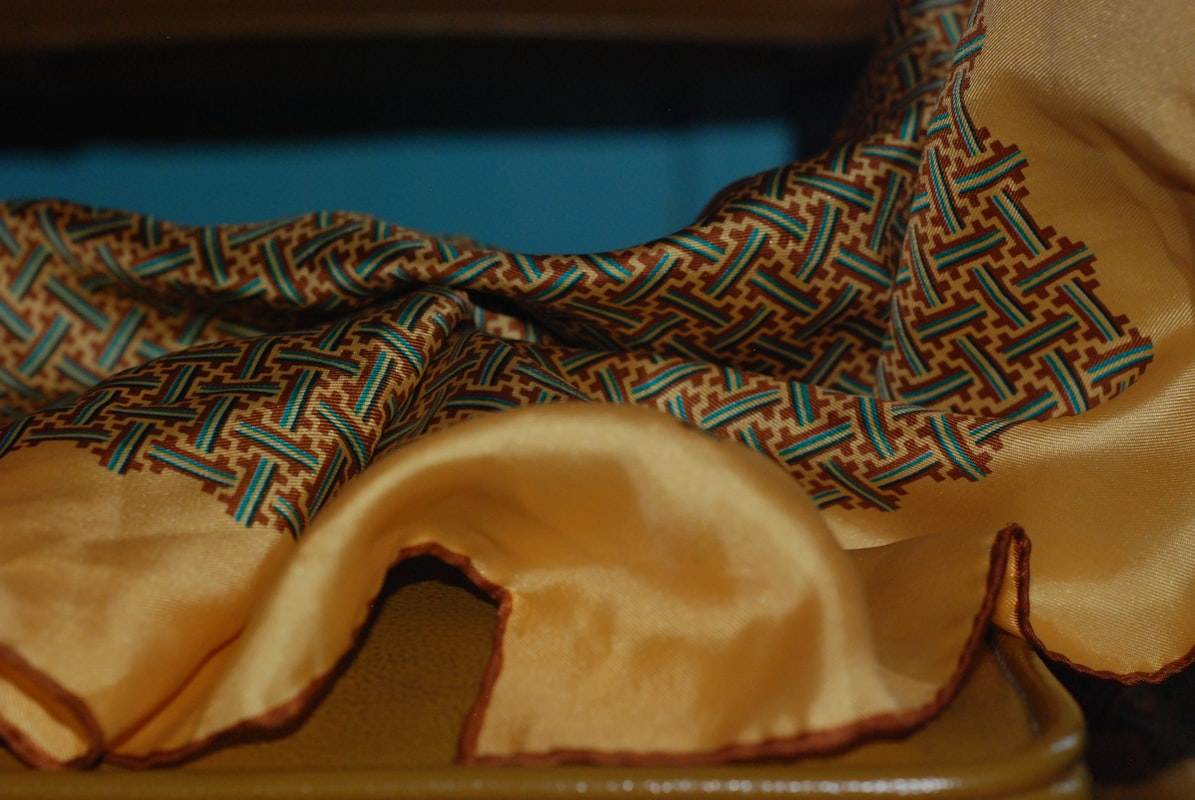
Everyone fixates on the Birkin. Fair enough, it is essentially a leather savings account with a waiting list. But here is the part the handbag obsessives tend to skip: the single easiest, most reliable way to own Hermès is not a bag at all. It is a 90 centimetre square of silk twill that costs $550, fits in your carry on, and has been holding its value since your grandmother’s generation. The Hermès scarf investment case is quiet, undramatic, and borderline boring compared to the theatre of scoring a B25, and that is precisely why it works. No sales associate games, no spending history, no hoping your profile is “right.” You walk into any Hermès boutique on earth, point at a Carré 90, and leave with it in an orange box. That accessibility is not a weakness. It is the entire point.
What makes the Carré 90 genuinely unusual in the luxury market is how many things it does simultaneously. It functions as wearable art, a styling tool with at least a dozen configurations, a collector’s item with a documented secondary market, and a store of value that retains roughly 85% of retail on resale platforms like Vestiaire Collective and The RealReal. Compare that to a $550 designer T shirt, which is worth about $40 the moment you remove the tags, or a mid range designer wallet that depreciates 60% in year one. The Carré does not pretend to be an investment in the hedge fund sense. It just quietly refuses to lose money, and for a first luxury purchase, or a fiftieth, that track record matters more than hype.
A Scarf That Predates the Birkin by Fifty Years
The Hermès Carré was born in 1937, conceived by Robert Dumas, son in law of Émile Maurice Hermès. The first design depicted women playing a period game surrounded by horse drawn carriages, equestrian heritage woven into silk from day one. Production was vertically integrated from the start: raw Chinese silk imported, spun, woven, screen printed, and hand rolled entirely by Hermès artisans. That eighteen month production cycle, from an artist’s initial sketch to a finished scarf, has barely changed in nearly ninety years. Each design can feature up to twenty seven colours, and the house releases approximately twelve new designs per season, split across spring and fall drops. Since 1937, Hermès has produced more than two thousand distinct Carré designs by over 150 artists, Hugo Grygkar, Robert Dallet, and Françoise de la Perrière among the most collected names. That archive is not just heritage marketing. It is a genuine creative catalogue that gives each scarf a specific provenance, season, and artist credit, details that matter enormously on the resale market.

The 2026 Price Picture: What You Actually Pay
After Hermès pushed through a 5% average increase on women’s silks in early 2026, the Carré 90 now retails at $550 in the United States. In Europe, depending on the colourway and whether you claim a VAT refund, you can still land one around €440-€490, which at current exchange rates shaves $40-$70 off the US price. For context, the Birkin 25 in Togo leather sits at $13,500 post January 2026 hike, and even the entry level Evelyne TPM is $2,525. The Carré 90 is, by a wide margin, the cheapest way to buy new Hermès at retail, and unlike a twilly ($210) or a pocket square, it has genuine collector and resale infrastructure behind it. Hermès also produces the Carré 70 (smaller, slightly cheaper) and the Grand Format 140cm shawl (roughly $1,150), but the 90cm square remains the collector’s standard and the one with the deepest resale data. If you are testing the waters with Hermès for the first time, this is the shallow end, and it is surprisingly deep.

Why the Resale Numbers Hold Up
An 85% average resale to retail ratio does not sound as sexy as the Birkin’s 120-140%, but adjust for entry cost and risk, and the Carré starts to look remarkably solid. A $550 scarf that resells for $465 means you effectively “rented” a piece of Hermès for $85 over however many years you wore it. Try that maths with a $3,000 Gucci bag that resells for $900. The Carré’s value retention is driven by three things: finite production runs (many designs print once and never return), the hand rolled hem authentication that makes fakes relatively easy to spot, and a robust collector community, Carré de Paris, Scarf Sage, PurseForum’s dedicated scarf threads, that keeps demand steady year round. At auction, Hermès scarves regularly trade between €200 and €9,600, with the extreme end reserved for rare 1950s prints and artist collaborations. On Vestiaire Collective today, a pre owned Brides de Gala in excellent condition sits around $350-$450, and a sought after discontinued colourway can exceed original retail. The floor is high and the ceiling, for patient collectors, is genuinely interesting.

The Five Designs Every New Collector Should Know
If you are starting a Hermès scarf investment with one piece, the classic designs offer the strongest resale baseline. The Brides de Gala, introduced in 1957 with its equestrian bridle motif, is the house’s best selling scarf of all time and appears on virtually every resale platform at any given moment, liquidity matters when you are thinking about value. The Ex Libris, featuring the Hermès bookplate crest, is the most “logo” a Carré gets while still feeling discreet. Jungle Love, with its leopard and tropical foliage, skews younger and photographs exceptionally well, a real consideration in the TikTok resale era. Astrologie Nouvelle appeals to the zodiac obsessed crowd, giving it a gifting premium. And Grand Apparat, dense with ceremonial horse tack, is the scarf that reads as unmistakably Hermès from across a room. All five retail at $550 in 2026, and all five have decades of resale data behind them. A first time buyer cannot really go wrong here, though a discontinued colourway in any of these patterns will always outperform a current season reissue on the secondary market.

How to Actually Wear a $550 Square of Silk
The worst thing you can do with a Carré 90 is leave it folded in a drawer. Hermès itself demonstrated this at the Spring/Summer 2026 show, where scarves appeared rolled and intertwined with chain necklaces as chokers, draped beneath leather harnesses as peek a boo tops, and threaded through belt loops to replace conventional belts. On TikTok, the scarf as top trend has pushed younger buyers toward the Carré 90 specifically because the 90cm dimension is large enough to wrap, tie, and knot into a genuine garment. Beyond the runway theatrics, the reliable everyday moves remain: the classic French knot at the neck under a blazer, a slim fold as a hair band, a loose drape across one shoulder over a simple black dress, or tied around a bag handle to refresh last season’s leather. The point is that this is not a display piece. Every wear gets you closer to cost per use parity with your most worn basics, and unlike a handbag, a silk scarf weighs nothing, packs flat, and works across every climate and dress code from a beach lunch in Byron Bay to a gallery opening in Mayfair.

Condition, Storage, and the Details That Protect Value
Silk is forgiving if you treat it with basic respect. Store your Carré flat or loosely rolled in its original tissue, never hang it on a hook, which stretches the weave at the fold point. Keep it away from direct sunlight, perfume (spray before you tie, not after), and sharp jewellery clasps. If it needs cleaning, Hermès offers a professional cleaning service through its boutiques, and a professionally cleaned scarf with its original box and care card will always command a premium over a bare scarf sold in a Ziploc bag on eBay. Authentication is straightforward for anyone familiar with the brand: look for the hand rolled hem (machine rolled edges are a dead giveaway for fakes), the artist’s name printed on the design, and the Hermès copyright tag sewn into one corner. If you are buying pre owned, stick to authenticated platforms, Vestiaire Collective, The RealReal, Rebag, or specialist dealers like Carré de Paris, and avoid unverified marketplace sellers.

Do’s and Don’ts
| Do | Don’t |
|---|---|
| Start with a classic design (Brides de Gala, Ex Libris) for strongest resale | Don’t buy solely based on resale speculation, wear what you love |
| Buy in store to guarantee authenticity and get the full orange box packaging | Don’t skip the box and care card, they add 10-15% to resale value |
| Store flat or loosely rolled in original tissue paper | Don’t hang on a hook or fold tightly, it stretches and creases the silk |
| Spray perfume on skin before tying the scarf, never directly on silk | Don’t expose silk to direct perfume, deodorant, or hairspray |
| Check the hand rolled hem when buying pre owned, fakes have machine edges | Don’t buy from unverified marketplace sellers without authentication |
| Explore discontinued colourways for better long term value appreciation | Don’t assume every Hermès scarf appreciates, common reissues hold steady, not rise |
| Try at least three styling methods, neck, hair, bag, belt, to maximise cost per wear | Don’t leave it in a drawer as a “collectible”, silk improves with gentle use |
| Use Hermès’s own cleaning service for professional care | Don’t dry clean at a generic cleaner, they often damage the print |
| Buy the Carré 90 specifically, it has the deepest resale market of any size | Don’t confuse the twilly or Carré 70 with the 90cm when comparing resale data |
| Track your scarf’s design name and season for future resale listings | Don’t toss the care booklet, collectors value complete sets |
FAQs
Is a Hermès scarf really a good investment compared to a Birkin? Different category entirely. The Birkin can appreciate 20-40% above retail if you secure one at the boutique, but a Birkin 25 costs $13,500 and requires a purchase history relationship with the house. The Carré 90 costs $550, is available to any walk in customer, and retains roughly 85% of retail on the secondary market. You will not double your money on a scarf, but you will not lose much either, and the barrier to entry is negligible. For a first Hermès purchase or a low risk addition to a luxury wardrobe, the scarf wins on accessibility and downside protection.

What is the difference between a Carré 90, Carré 70, and a twilly? The Carré 90 measures 90 x 90cm and is the house’s signature format, large enough to tie as a top, drape as a shawl, or wear as a traditional neck scarf. The Carré 70 is 70 x 70cm, slightly smaller and suited to neck only styling. The twilly is a narrow rectangular strip (86 x 5cm) designed primarily for wrapping bag handles or wearing as a thin headband. From a resale and collecting standpoint, the Carré 90 has by far the most active secondary market and the most documented price history.
How can I tell if a Hermès scarf is authentic? Three things to check immediately: the hand rolled hem, which should be tight, even, and slightly raised compared to machine rolled edges; the artist’s name and the “Hermès, Paris” print on the design itself; and the copyright tag sewn into one corner with a care label. Authentic Hermès silk has a specific weight and sheen that is difficult to replicate cheaply. When in doubt, buy from authenticated resale platforms like Vestiaire Collective, The RealReal, or Rebag, or take a pre owned piece to an Hermès boutique for informal verification.
Which Hermès scarf designs hold the most value? The top five by resale consistency are Brides de Gala, Ex Libris, Astrologie Nouvelle, Jungle Love, and Grand Apparat. All are regularly reissued in new colourways, which keeps demand alive. However, discontinued colourways of these classic designs, particularly from the 1960s through 1990s, can command significant premiums at auction, sometimes reaching €5,000-€9,600 for rare prints in mint condition. Single run designs by sought after artists like Hugo Grygkar also perform well.
Can I actually wear a Hermès scarf casually, or is it too formal? The formal reputation is outdated. Hermès’s own SS26 runway showed scarves threaded through belt loops, knotted as choker necklaces, and layered under harnesses as crop tops. On TikTok, the Carré 90 has become a genuine styling staple for Gen Z creators who tie it as a halter top with jeans or use it as a headscarf with oversized sunglasses. The 90cm dimension is specifically what makes casual styling possible, it is large enough to wrap, twist, and knot into shapes that a smaller scarf cannot achieve.
How should I clean my Hermès scarf? Hermès offers a professional silk cleaning and pressing service through its boutiques, and this is the safest option for valuable or vintage pieces. For light refreshing between professional cleanings, some collectors use a very gentle hand wash in lukewarm water with a pH neutral silk detergent, followed by air drying flat on a towel, but this carries risk if the scarf has older or more delicate printing. Never machine wash, tumble dry, or send to a standard dry cleaner, as the solvents can damage the pigment and weaken the silk fibres.
Is it better to buy new from the boutique or pre owned? Both are valid strategies. Buying new guarantees authenticity, pristine condition, the full orange box presentation, and current season designs. Buying pre owned gives you access to discontinued colourways and designs that may appreciate more than current production pieces, and typically at 15-30% below original retail. For a first purchase, the boutique experience is part of the appeal. For building a collection with an eye on value, the secondary market through authenticated dealers is where the interesting finds live.
How many Hermès scarves should a collector own? There is no magic number, but the practical sweet spot for someone building a functional luxury wardrobe is three to five: one classic equestrian print (Brides de Gala or Grand Apparat), one geometric or abstract design for modern outfits, one bold colour for statement styling, and optionally a vintage piece for collector credibility. Beyond five, you are building an art collection, which is a perfectly legitimate pursuit, Hermès has released over two thousand designs, and some collectors frame and rotate them as wall art.
Conclusion
The Hermès scarf investment thesis is not about getting rich. It is about owning something handmade, historically significant, and almost impossible to lose money on, at a price point that does not require a second mortgage or a secret sales associate relationship. At $550 for the Carré 90 in 2026, with 85% resale retention and nearly ninety years of unbroken production behind it, this is as close to a guaranteed value luxury buy as the market offers. Start with one classic, wear it constantly, and see how you feel about Hermès before chasing orange boxes with five figure price tags.