

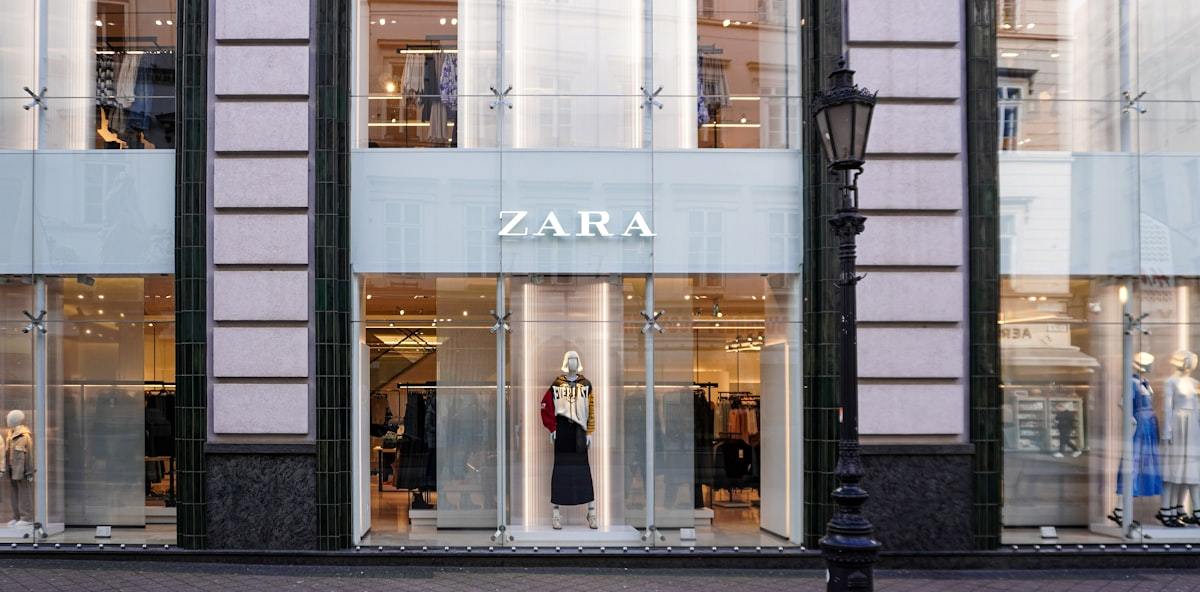
If you want to know what walked down the Milan runways six weeks ago, you don’t need a Vogue Runway subscription anymore, you need a fifteen minute lap around a flagship Zara. The chartreuse silk that rippled through Bottega Veneta’s SS26 show is already hanging on the Zara Woman rail. The Prada underwire bib hybrid has been translated into a €29.95 ribbed tank. The woven leather mini tote that Bottega’s Matthieu Blazy sent down the runway in his last collection has an uncanny cousin in the Zara accessories wall for €49.95. This is the Zara runway dupes 2026 machine in full swing, and it’s the single most efficient trend to shelf pipeline in global fashion.
The brand’s omnipresence isn’t an accident. Inditex, Zara’s Galician parent, just reported FY25 net sales of €39.86 billion and a net profit of €6.22 billion, with Q1 2026 revenue accelerating 9% in the first five weeks of the fiscal year. Zara alone accounts for roughly 70% of that empire. The reason any trend you spotted on the SS26 runways, balloon hems, fringe, chartreuse, penny loafers with exaggerated toes, is already sitting on a hanger in your local store comes down to a logistics operation most luxury houses quietly envy. Understanding how Zara actually works makes you a smarter shopper, whether you’re hunting a Zara Bottega dupe or trying to decode what the next six months of your wardrobe should look like.
The Two Week Lead Time That Changed Fashion
The most quoted number in fashion business schools is Zara’s two week design to store lead time, and it’s basically true for existing items being modified. New from scratch pieces run closer to four to six weeks, but even that is laughable compared to the industry’s traditional six month cycle. The mechanics are specific: roughly 60% of Zara’s production happens in Spain, Portugal, Morocco and Turkey, what Inditex calls “proximity sourcing”, rather than being shipped from Bangladesh or Vietnam. Goods fly out of the Arteixo logistics hub in Galicia twice a week to every store on earth, with a system internally called Rapid Fire Fulfillment. This is the infrastructure that makes the Inditex Zara strategy so hard to replicate: H&M, Mango and Uniqlo all design beautifully, but none of them can turn a runway screenshot into a floor ready SKU before the reviews have even been filed.

How Zara Buyers Actually Source Trends
The myth is that Zara rips off designer collections. The reality is more interesting, and more litigious adjacent. Zara employs a network of what the trade calls “trend scouts,” but the real sourcing engine is the store managers. Every Zara store feeds daily sell through data back to Arteixo, where around 700 in house designers sit at long tables sketching in response to what customers actually picked up yesterday, what they left on the rail, and what the visual team photographed on the streets of Milan, Seoul and Copenhagen that morning. Runway is only one input. Pinterest searches, TikTok virality, and the clothes worn by editors leaving the Prada show all get translated into tech packs within 72 hours. By the time Vogue publishes its “ten takeaways” article, a Zara buyer has already cut the fabric order.

Zara Woman vs TRF vs SRPLS: The Three Zaras You Need to Know
Walk into any flagship and you’re really walking into three stores stitched together. Zara Woman is the grown up, editorial heart of the brand, the tailored wool trousers, the cashmere blend knits, the €79.95 blazers that get photographed on Sofia Richie and Alexa Chung. It’s where most of the convincing Zara trends SS26 pieces live, because it’s priced to compete with COS and Arket rather than Primark. TRF (Trafaluc) is the younger, trend first line: cropped, denim heavy, club ready, and the source of roughly 80% of what TikTok tags “Zara haul.” It’s where the balloon hem trousers and the cargo micro skirts show up first. Then there’s Zara SRPLS, launched in 2018 and now in its 14th season, a twice yearly utility capsule of grommets, patch pockets, and artfully oversized silhouettes that looks more like a Margiela side project than a high street drop. SRPLS is where the brand flexes its editorial muscle and quietly charges €139 for a parka.

The Bottega Veneta Problem: When Is a Dupe Actually a Dupe?
No luxury house has been Zara ified quite as thoroughly as Bottega Veneta. The intrecciato woven leather mini bag, the square toe padded mule, the rubber Puddle boot, every single one has had a Zara Bottega dupe on the shelf within weeks. Some of them are close enough that fashion lawyers raise eyebrows; most are just close enough that the silhouette reads from across a room. The ethical conversation is real, but so is the shopping calculus: a Bottega Cassette bag is €3,200, and a very similar Zara woven tote is €49.95. What you lose is the leather quality, the hardware weight, and the resale value. What you get is the exact look, for 1.5% of the price, and a bag you can actually put a water bottle into without crying. Smart shoppers use Zara for the silhouettes that are dated by next August and save their real money for the pieces they’ll keep a decade.

What SS26 Means for Your Zara Trip in April 2026
Right now, in April 2026, the Zara floor is halfway through its SS26 rollout. The pieces worth hunting: any silk feel slip dress in chartreuse or acid yellow (the Bottega colour story), anything with a woven or macramé detail, chunky penny loafers in the TRF shoe wall, and the SRPLS Woman utility shirting that dropped in March. Skip the heavily logo’d T shirts, they always age badly, and treat the trend forward bag wall as rental fashion, not investment. The €39.95 raffia tote will carry you through summer beautifully and then go into a donation pile. That’s the deal with Zara: you buy for the season, not for the archive. If you want archive, you save up for the actual Bottega. For a deeper breakdown of where to spend versus where to save, our guide to Luxury vs Budget Fashion: What Should Women Invest In goes line by line.

Do’s and Don’ts
| Do | Don’t |
|---|---|
| Shop Zara Woman for blazers, trousers and coats, the quality to price ratio is highest here | Don’t buy the obvious logo lookalike, it dates in one season |
| Check SRPLS drops twice a year for utility pieces that actually last | Don’t treat Zara leather as real leather, it’s mostly bonded or PU |
| Use TRF for micro trends you’ll wear for three months max | Don’t invest in Zara knitwear expecting cashmere longevity |
| Buy the Bottega adjacent bag if you love the silhouette, not the label | Don’t skip trying on, Zara sizing varies wildly between lines |
| Follow store restocks on Tuesdays and Fridays (Arteixo ships twice weekly) | Don’t buy online without checking the model’s height, drape is everything |
| Shop Zara Woman tailoring within two weeks of runway season | Don’t wait for sale on trend pieces, they sell through fast |
| Cross shop Massimo Dutti (also Inditex) for the grown up version | Don’t assume every Zara store carries SRPLS, it’s flagship only |
| Use the app’s barcode scanner to check other store stock | Don’t buy shoes online, Zara shoe sizing is notoriously off |
| Keep receipts: returns are 30 days in store, 14 days online | Don’t trust the styling photos, they’re aspirational, not accurate |
| Treat Zara as a supplement to investment pieces, not a replacement | Don’t build a wardrobe entirely from Zara, the cost per wear math stops working |
FAQs
How does Zara get runway trends into stores so fast? The two week figure refers to existing product modifications, a colour change, a neckline tweak, not brand new designs. New pieces take four to six weeks. The speed comes from proximity sourcing (60% of production is in Spain, Portugal, Morocco and Turkey), vertical integration through Inditex owned factories, and a logistics hub in Arteixo that ships to every global store twice a week. Store managers feed daily sell through data back to 700 in house designers, which means buying decisions respond to real demand in near real time.


What is Zara SRPLS and is it worth the higher price? Zara SRPLS is the brand’s twice yearly utility capsule, launched in 2018 and now in its 14th season. It sits above Zara Woman on price, a parka runs around €139, trousers around €69, but the fabrics are heavier, the construction is more considered, and the silhouettes are closer to independent labels like Margaret Howell than to mainline Zara. If you love workwear, patch pockets and hardware details, it’s the most editorial thing on the Zara floor.
Is buying a Zara Bottega dupe actually ethical? It’s a grey area. Zara has faced lawsuits and settlements over design similarities with specific designers, but silhouettes and trends legally can’t be copyrighted. The honest framing: dupes democratise luxury aesthetics for people who will never afford the original, but they also devalue the craft of the houses doing the original design work. Most shoppers buy dupes for pieces they want to wear for a season and buy genuine luxury for pieces they want to keep.
What’s the difference between Zara Woman and Zara TRF? Zara Woman is the tailored, grown up main line, think wool blazers, silk blouses, leather feel trousers, priced €49.95 to €199. TRF (Trafaluc) is the younger, trend driven sub line, cropped tops, denim, party dresses, priced lower and aimed at the under 25 shopper. They share stores but not aesthetics. If you’re over 28 and want pieces that photograph well for work, shop Woman. If you want to try SS26 balloon hems or cargo mini skirts for €35, go TRF.
How big is Inditex compared to the rest of fast fashion? Enormous. Inditex reported €39.86 billion in net sales for FY25 (year ending 31 January 2026) and €6.22 billion in net profit. That makes it the biggest fashion retailer on earth by revenue, ahead of H&M and Uniqlo parent Fast Retailing in most metrics. The Inditex Zara strategy is to grow selectively, they closed 1,500 smaller stores over the past five years in favour of mega flagships, while pouring capex into automation and online logistics.
When do new SS26 pieces actually hit the floor? Zara drops in micro waves, not seasons. SS26 began rolling out in late January 2026 and continues through May, with new deliveries twice weekly. If you saw something on the Zara Instagram, walk into a flagship within 48 hours, popular pieces sell out in days and rarely restock. The app’s “coming soon” section is more reliable than the main site for tracking drops.
Are Zara clothes good quality for the price? It’s genuinely mixed. The tailoring and outerwear in Zara Woman punch above their weight, a €79.95 blazer often rivals a €200 COS blazer in cut and fabric. Knitwear is the weak spot: most pieces are acrylic blends that pill within three washes. Shoes are hit and miss. SRPLS is the most consistent for quality. As a rule, buy structured pieces at Zara and buy knitwear somewhere else.
Does Zara ever translate haute couture, not just ready to wear? Rarely with precision, but yes in spirit. Couture’s volumes, drape and embellishment ideas filter down into Zara Woman evening pieces, especially the twice yearly “Collection” drops, which are more expensive, limited run, and editorially styled. These are the closest Zara gets to a capsule that references the Chanel or Schiaparelli shows rather than the ready to wear calendar.
Conclusion
Zara is no longer fast fashion the way H&M is fast fashion, it’s become something weirder and more interesting: a real time translator that turns the Bottega runway into a €49.95 silhouette before most editors have filed their reviews. Knowing how the machine works, Woman versus TRF versus SRPLS, when drops land, which categories are actually worth the money, is the difference between building a wardrobe and building a donation pile. Shop the Zara runway dupes 2026 drops smart, save your serious money for the pieces you’ll keep, and let the Inditex supply chain do the trend hunting for you. For more on where to spend and where to fake it, keep reading the rest of our Luxury vs Budget Fashion guide.