

For a decade, Ganni was the Copenhagen label you bought when you wanted to look like you read i D on the weekends. Leopard midi dresses, smiley face socks, butter yellow raincoats, a Bou bag dangling off one wrist, the uniform of every editor shooting street style outside Hotel d’Angleterre during Copenhagen Fashion Week. Then Ganni FW26 happened inside a Paris showspace in March, and the whole tone shifted. The smileys were gone. In their place: faux shearling the weight of a duvet, lace bloomers trailing out from under chunky fisherman knits, leopard so enlarged it looked almost abstract. The Ganni Girl, it turns out, has grown up, and the brand is quietly repositioning itself somewhere between high street darling and proper mid luxury house.
This isn’t a small thing. Ganni Copenhagen has spent years being the reference point for how to do Scandinavian cool without slipping into The Row territory or Acne Studios minimalism. But Ditte Reffstrup’s Fall 2026 collection, shown in Paris, not Copenhagen, with Laura du Rusquec (ex Balenciaga deputy CEO) now steering the business, reads like a deliberate maturation. It’s still recognisably Ganni, still playful in the margins, but the silhouettes are heavier, the styling more considered, the price points inching upward. If you’ve been tracking the Ganni pivot across SS26 and resort, FW26 is the season it clicks into focus. Here’s what actually happened on the runway, why it matters, and what it signals for every other Scandi brand still trying to figure out whether to stay cute or go grown up.
The Ganni FW26 Show: What Ditte Actually Put on the Runway
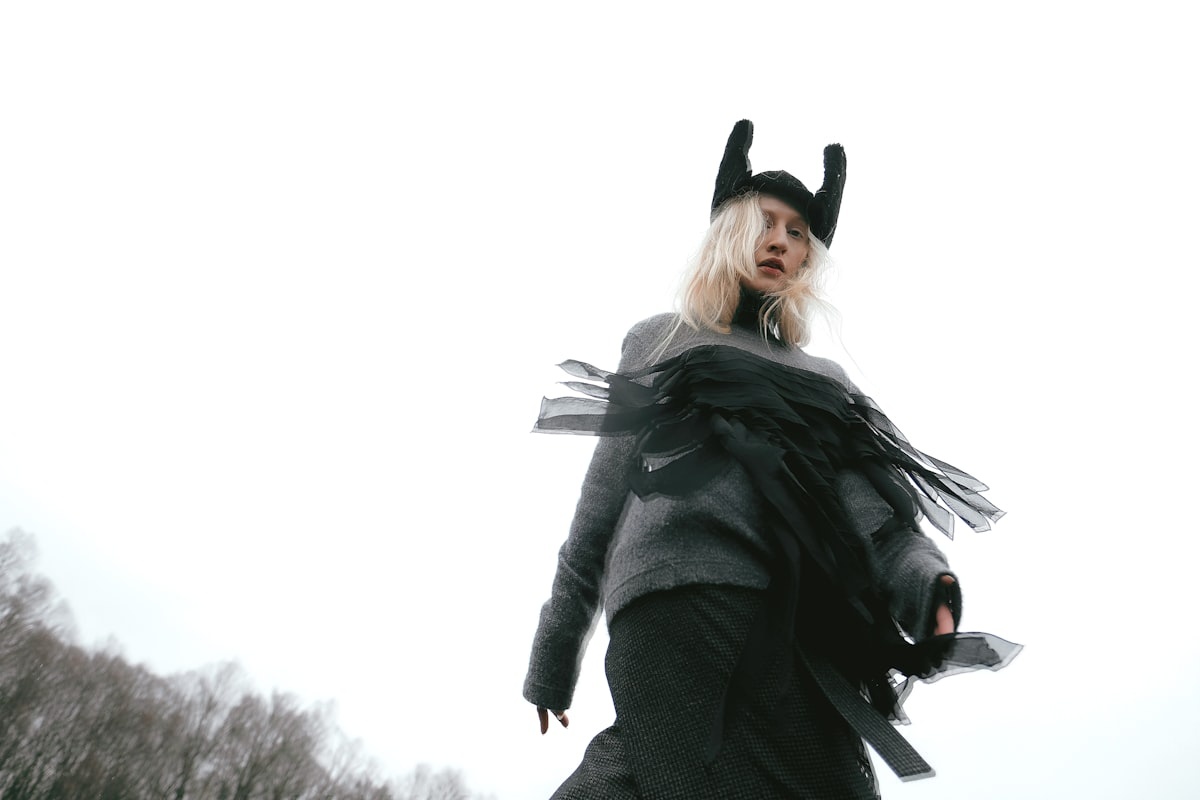
Reffstrup staged the FW26 presentation in Paris with a live painter working throughout the show, a detail she said captured “toughness and fragility,” the two poles she was designing between. The mood reference was her own childhood in Hirtshals, the windiest town on the northern Danish coast, layered with a Björk soundtrack playing in her head. What came down the runway matched it: chunky oversized knits in oatmeal and charcoal, blanket skirts that looked heavy enough to sleep under, faux shearling coats with deep collars, and underneath all of it, slips and bloomers edged in delicate lace. Leopard appeared again (of course, this is still Ganni) but reworked at a much bigger scale, layered against checks and electric florals over brown and stone backgrounds. The palette was earthier than past Ganni outings, punctuated by sharp green, purple, and mustard instead of the usual bubblegum pink. It felt less “girl” and more “woman who spends winters in a cottage in Jutland and reads Tove Ditlevsen.”

Ditte Reffstrup’s Vision: From Copenhagen Girl to Grown up Woman
Ditte Reffstrup has been the creative engine of Ganni since she and her husband Nicolaj bought the business in 2009, and she’s very rarely talked about wanting to go upmarket. Her whole brand story has been about accessibility, playfulness, and making clothes a Copenhagen 28 year old would actually wear to the office and then to drinks. But in her FW26 interviews, you can feel the language shifting. She’s talking about “grown up,” about “fragility,” about her own memories of a wilder, less Instagram friendly Denmark. She’s also openly acknowledging that understanding both Paris and Copenhagen is now shaping her design language, which is a polite way of saying the brand is no longer just speaking to the Scandi street style circuit. With the flagship that opened on Rue Saint Honoré last October and a new Paris headquarters, Ganni Paris show season is clearly now the main event, and Copenhagen Fashion Week is the friendly home game.

Why FW26 Signals a Real Ganni Pivot (Not Just a Mood Board)
A runway collection on its own is just a runway collection. What makes the Ganni FW26 pivot real is the business context around it. In late 2025, Laura du Rusquec, who spent years as deputy CEO at Balenciaga under Demna, was appointed Ganni’s new chief executive, replacing Andrea Baldo. You don’t hire someone from the Kering luxury machine to run a cute Scandi dress brand unless you have ambitions that go beyond cute. Ganni also closed its UK office and is openly calling Paris its next “global platform.” Revenue has compounded at roughly 22% annually over the last three years, the Bou bag has become a genuine It bag at around $545, and accessories are eating a bigger share of the business every season. FW26 introduced the “Very Bou”, a larger, locked version of the Bou, plus the Jenny boot, built off last season’s studded ballerina. Bigger bags, harder shoes, heavier outerwear: these are all classic signs of a brand trading up.

Scandinavian Luxury: The Lane Ganni Is Trying to Own
Here’s the strategic bit. The Scandinavian luxury conversation has, until recently, been dominated by two extremes. On one side: actual luxury houses with Scandi DNA, like The Row adjacent Toteme (silk scarves, $890 coats, very quiet) and Khaite (which isn’t Scandi but shares the lane). On the other: high street giants like COS, Arket and & Other Stories, all sitting under H&M Group, all capped around the €200 dress mark. In between, there’s been no obvious leader. Acne Studios tried, but it reads more Paris arty than Copenhagen clean. Stine Goya is too whimsical. Ganni, with its $250-$400 dresses, $545 bags, and now a Paris address, is essentially planting a flag in that empty middle and saying: this is Scandinavian luxury, and we run it. FW26 is the aesthetic argument for why they deserve the spot, grown up enough to sit next to Khaite on a Net a Porter edit, distinctive enough not to disappear into the quiet luxury beige wash.

How the Ganni Pivot Reshapes the Rest of the Scandi Brand Landscape
If Ganni successfully pulls off the mid luxury move, every other Copenhagen label has a decision to make. Stine Goya either leans harder into maximalist whimsy or gets squeezed. Cecilie Bahnsen, which already sits higher at $1,500+ for a dress, might actually benefit, because it reads as the true luxury rung above Ganni. Saks Potts has to sharpen its point of view beyond the shearling coat. And the next wave (Rotate, Remain, Baum und Pferdgarten) suddenly have a clearer ceiling of where the “accessible Scandi” lane ends and where the aspirational one begins. For shoppers in the US, UK and AU, the practical impact is that Ganni is going to feel more aspirational and slightly harder to justify on impulse, but probably more investment worthy. If you’ve been sitting on a Bou bag wishlist, FW26 is the season to commit, because pricing is unlikely to go backwards. For more on navigating this kind of spend, our guide to luxury vs budget fashion is a useful gut check.

The Sustainability Story Isn’t Going Anywhere
One thing that hasn’t shifted in the Ganni FW26 pivot is the sustainability spine. Reffstrup used the show to push Ganni’s Fabrics of the Future programme forward with three materials: Ohoskin and Oleatex (leather alternatives made from orange and olive oil waste) and InResST, a recycled nylon spun from discarded ocean fishing nets, used across the puffers and soft accessories. This matters because the easiest trap for a brand trading up is to quietly drop the ethics that made it interesting in the first place. Ganni is doing the opposite, making the premium version of itself more sustainable, not less, which gives the pivot a credibility that a lot of upmarket moves lack. If you’re comparing it to, say, how Coach handled the Tabby era repositioning, it’s a smarter play long term.

Do’s and Don’ts: Shopping Ganni in the FW26 Era
| Do | Don’t |
|---|---|
| Invest in the Bou bag now before pricing climbs again | Assume the smiley face Ganni aesthetic is still the brand’s main thing |
| Size up in the FW26 chunky knits, they’re cut oversized on purpose | Layer lace slips over jeans; Ditte’s styling is lace under knits, not over denim |
| Watch the Jenny boot as a hero accessory for winter | Buy the leopard pieces if you already own three; this drop is heavier and harder to rotate |
| Shop the Ohoskin and Oleatex pieces if you care about materials | Ignore the resort drops, they’re where the accessible prices still live |
| Mix Ganni FW26 with Toteme and COS for a grown up Scandi stack | Pair it with ultra girly labels; the new mood is tougher |
| Use Net a Porter and Matches for sale windows on last season Ganni | Buy fakes of the Bou bag, the hardware gives them away instantly |
| Follow Ditte Reffstrup directly for styling cues | Rely on old “Ganni Girl” Pinterest boards; they’re out of date |
| Treat FW26 pieces as 3 year wardrobe investments | Expect Ganni to pivot back to quirky cute anytime soon |
| Pair the Very Bou with tailoring to lean into the mid luxury angle | Wear it with joggers, that era is over for this brand |
| Check the Paris flagship if you’re in the city; the edit is tighter than online | Assume Copenhagen stores carry the full runway |
FAQs
Is Ganni FW26 actually more expensive than previous seasons? Yes, modestly. Dresses that used to hover around €230 are now closer to €280-€320, and the Bou bag family has crept up from its original $445 launch price to around $545 for standard sizes, with the new Very Bou sitting higher again. The increase isn’t dramatic enough to alienate the core customer, but it’s consistent with the Ganni pivot toward mid luxury. Expect this trajectory to continue under the new CEO, especially on leather goods and outerwear, which is where most mid luxury brands concentrate their margin growth.

Why did Ganni show in Paris instead of Copenhagen Fashion Week? Because Paris is now where Ganni wants to be read. Copenhagen Fashion Week is brilliant for trend generation and street style momentum, but it doesn’t carry the global buyer and editor weight that Paris does. By showing during Paris Fashion Week, Ganni gets reviewed alongside houses like Chloé, Isabel Marant and Stella McCartney rather than alongside smaller Scandi labels. It’s the same move Jacquemus made years ago, and it’s working. Ditte Reffstrup has been clear that Ganni Copenhagen remains the brand’s heart, but Ganni Paris show is now the commercial and editorial stage.
Who is Laura du Rusquec and why does her appointment matter? Laura du Rusquec was deputy CEO at Balenciaga for years, working through the brand’s biggest growth phase under Demna and Kering. She was named Ganni’s new CEO in late 2025. Her hire matters because it signals Ganni’s owners, investment firm L Catterton, which bought a majority stake back in 2017, are preparing the brand for a much bigger chapter, possibly including accelerated store rollout, tighter product architecture, and eventually an exit. You don’t bring in Kering trained executives to run a brand you intend to keep small.
Is the Ganni Bou bag worth buying right now? If you’ve been considering one, FW26 is a reasonable time to commit. The Bou is now Ganni’s signature accessory, it’s been endorsed by enough editors and celebrities to have real recognition, and prices are trending up, not down. The standard Bou in a neutral colour is the safest bet; the Very Bou is more of a statement piece. Skip the very trend led colours unless you’re confident you’ll wear them for three seasons. For a broader take on when to spend on bags, our piece on how to look expensive on a budget pairs well with this.
How is Ganni different from Cecilie Bahnsen now? Cecilie Bahnsen is genuinely luxury, $1,500+ dresses, romantic sculptural silhouettes, sold mostly through high end boutiques and Dover Street Market. Ganni is, and will remain, a step below that: more wearable, more accessible, more commercial. The Ganni FW26 pivot doesn’t close that gap. What it does is widen the distance between Ganni and the high street Scandi brands like COS and & Other Stories, planting Ganni firmly in the middle tier where Toteme, Khaite lite, and Nanushka also play.
Will the classic “Ganni Girl” aesthetic come back? Probably not in its original form. Ditte Reffstrup hasn’t disowned the playful DNA, there were still flashes of it in FW26, in the florals and the colour pops, but the core mood has clearly shifted toward something more adult. If you loved the old smiley socks and butter yellow coat era, the good news is there’s a huge resale market for vintage Ganni on Vestiaire Collective. The brand itself is moving on.
Does the sustainability messaging actually hold up? More than most mid luxury peers, yes. Ganni publishes annual progress reports, has committed to specific climate targets, and FW26 introduced three new lower impact materials, Ohoskin, Oleatex and InResST, into real production pieces, not just runway one offs. It’s not perfect (no brand producing at Ganni’s volume is), but compared to how quietly most houses drop their sustainability commitments when they trade up, Ganni’s version is credible.
Where should I shop Ganni FW26 when it drops? The full runway edit hits Ganni’s own site and flagships first, usually followed by Net a Porter, Matches (relaunch pending), Browns, and Selfridges. For the best price, wait for the mid season sale window in November or watch Vestiaire Collective for lightly worn pieces from press gifting. The Paris flagship on Rue Saint Honoré reportedly has a tighter, more considered edit than the e commerce grid, so it’s worth a visit if you’re in the city.
Conclusion
Ganni FW26 isn’t a rebrand, it’s a coming of age. Ditte Reffstrup has found a way to keep the Copenhagen DNA intact while pushing the silhouettes, the accessories and the attitude somewhere grown up enough to earn a Paris front row. With Laura du Rusquec steering the business, this is very clearly the start of the Ganni pivot into real mid luxury territory, and for once, the aesthetic argument and the boardroom move are in sync. If you’ve been a Ganni shopper for a while, this is the season to reassess what you buy and why. If you’re new, start with the Bou bag and work outwards.